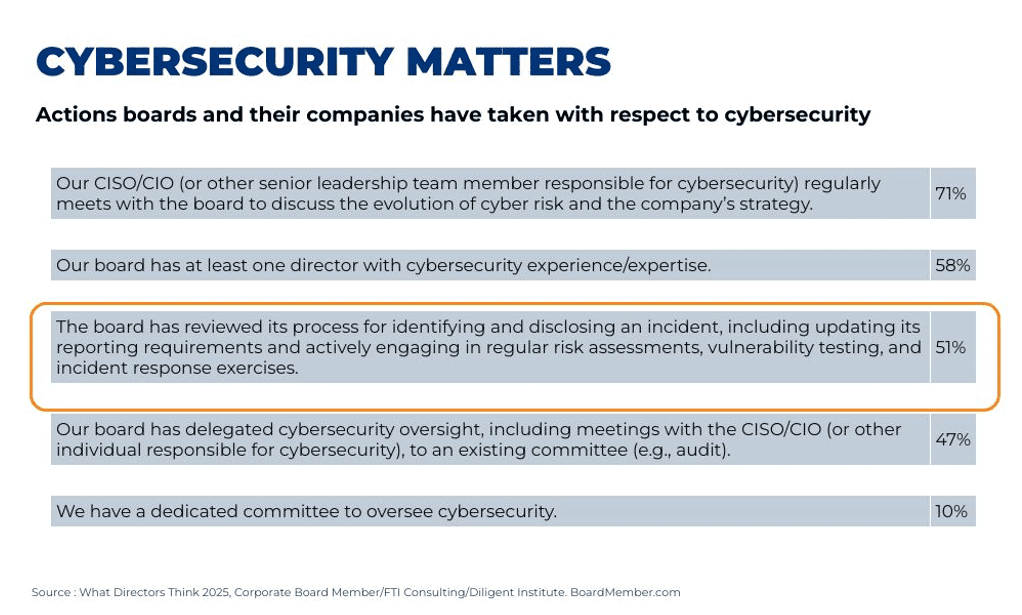
For years, cyber risk was treated as a technical issue - something to be managed by IT teams, security tools, or outsourced providers. That position is no longer defensible.
Across the UK and EU, regulators now explicitly frame cyber risk as a board-level governance and accountability issue, embedded within enterprise risk management and operational resilience.
This shift is not theoretical. It is visible in regulatory language, enforcement actions, and supervisory expectations.
The regulatory shift boards can no longer ignore
UK regulators, led by the Financial Conduct Authority, have made it clear that operational resilience, including cyber resilience, is a matter of senior management accountability. Under frameworks such as SMCR, responsibility cannot be delegated away from accountable executives.
At the same time, enterprise risk frameworks such as COSO ERM explicitly categorise cyber risk as a principal enterprise risk, alongside financial, operational, and regulatory risk.
Guidance from the National Cyber Security Centre reinforces this position, consistently emphasising that boards must:
- Understand cyber risk in business terms
- Oversee decision-making
- Challenge management assumptions
- Evidence governance, not just controls
Cyber risk now sits squarely within the board’s duty of care.
What regulators assess after an incident
When incidents occur, regulators do not start by asking which tools were deployed.
Instead, scrutiny focuses on governance:
- Was cyber risk formally identified and prioritised?
- Was risk ownership clearly assigned?
- Were trade-offs discussed and approved?
- Did the board receive regular, decision-ready insight?
- Were risk acceptance decisions documented?
A lack of evidence in these areas is increasingly treated as a governance failure even where technical controls existed.
The most common board failure mode
Many boards believe cyber risk has been “handled” because:
- An MSP is in place
- Security tools are deployed
- Compliance certificates exist
But delegation without governance is not compliance.
Outsourcing delivery does not outsource accountability. Regulators expect boards to demonstrate how and why decisions were made - not simply that services were purchased.
The RockSec360 perspective
At RockSec360, we start from a simple principle:
Governance is recorded decision-making under uncertainty.
Our platform is designed to help boards and leadership teams:
- Translate cyber risk into business and financial language
- Establish clear ownership and accountability
- Evidence oversight on an ongoing basis
- Demonstrate defensible governance to regulators, insurers, and clients
This is not about more reporting.
It is about better decisions, properly evidenced.
Start with clarity.
Our Cyber Risk & Compliance Scorecard provides a board-ready view of your current governance posture in under 8 minutes.